|
|
William Friedkin recently said,
"There is no way to write about what Benicio does – it just comes through."
A quote such as that may not be the best way to start an introduction, one
in which I will attempt, for a sentence or two, to write about what Benicio
Del Toro does. But if I may add, whatever ineffable quality Del Toro has, a
presence, a world-weariness, an intensity (and don't forget about the
humor), he treats moviegoers to a performance with edge. Looking beyond his
Oscar for Traffic, take for example his performances in Fear and
Loathing in Las Vegas as the inebriated (among other influences) Dr.
Gonzo, Snatch as Franky Four Fingers, and The Pledge as the
falsely accused Toby Wadenah, and you get the idea.
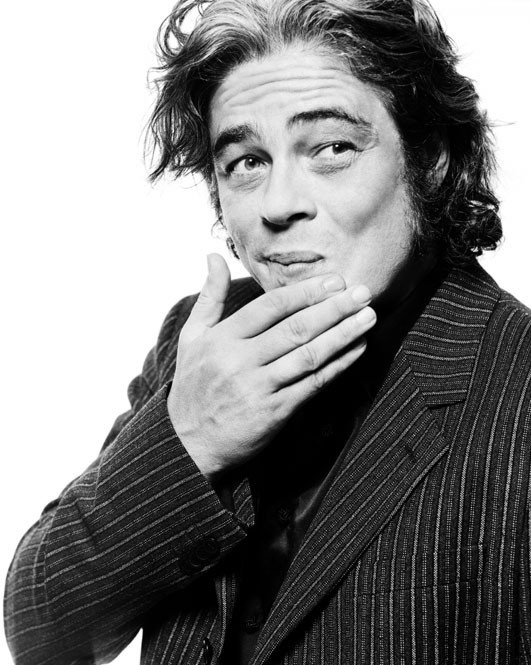
Del Toro – in a light gray shirt and a green "Memphis Music USA" cap –
speaks softly. Giving each question consideration, he pauses, at times
bringing his hand to his chin, or looking off to the side, searching for the
right word. We discuss his new film, The Hunted, with Del Toro as
lead, not supporting actor. But more than that, he talks about his first
job, his first acting gig, and how winning an Oscar affected his career.
Q: What was that that initially drew you to The Hunted?
BENICIO DEL TORO: The attraction first was Billy Friedkin. That's how I
got pulled into the story, or into the project. And then the next thing was
Tommy Lee Jones.
Q: Your character, Hallam, he's rather silent. Isn't he?
DEL TORO: [He] eventually evolved into this silence. People keep talking
about the silence, but yeah I guess it is the silence. It's more like, "Boy
I'm running here, I'm in the middle of a fight" ... It's not all sitting
down; it's a lot of fighting. Not that I'm good at it or like it, unless
you're Muhammad Ali. (He laughs.)
Q: But the character is a very quiet character.
DEL TORO: Yes. Right.
Q: And what sort of challenges did that presented to you?
DEL TORO: I like it. I think that I like that. It brings the audience in
... it pulls you inside to what's he thinking.
Q: What do you think is unique about William Friedkin as a director?
DEL TORO: That he doesn't do any press. (He laughs)
Q: And that's true – he didn't do the press days for The Exorcist
re-release.
DEL TORO: Well I think one thing that he does have is – when I saw the
film – it's like a great ear. The sound is fantastic. On the set he knows he
wants, and he really knew what this movie was going be. He didn't ... start
by going, "Well, you know, my character..." Any of that stuff. That's
[inevitably] going be on the editing room floor. I knew that he wanted this
movie to move! Move! Move! So that was kind of good.
Q: How have perceptions changed since winning the Oscar? What kinds of
things have happened to you?
DEL TORO: Phew. (He smiles) I get more choices of things, projects,
which is a blessing and a curse. I can only do one at a time. Sometimes you
don't know which way to go.
Q: Do you think you're getting better at that, choosing projects?
DEL TORO: Done pretty good. (He nods.) I think I've done pretty good. I
mean I like most of the films that I've seen that I've been in. Those are
the kind of films that I like to see. Am I getting better at making choices?
Well, I think I might be getting better at reading scripts. Does that
make any sense? (He laughs.)
Q: Was the Oscar a genuine
surprise?
DEL TORO: Yes. I mean ... standing up there, looking out at the crowd
and everywhere you look you see Dustin Hoffman and everyone. That's really
shocking. That's my memory when I was up in there – looking down and seeing
Dustin Hoffman.
Q: Maybe another element of getting the Oscar was working with other
talent that you may not have I had the opportunity to work with.
DEL TORO: Absolutely. And also ... it gives you more of a leverage on
your career. It's like good for the business side. But I don't think it's
much of the curse, unless it starts to change your approach of the work. And
it hasn't with me. If you start thinking like, "Now I won the Oscar." I
mean, and you start believing that now you don't have to like read the
scripts or whatever. You might start to think, "I'm that talented. I
never thought I was that talented.
Q: Not many complaints.
DEL TORO: Exactly. I mean, it isn't negative. And, you know, I love
film. I love film.
Q: Would you describe yourself as a workaholic? Do you really have to
have work and be working on a lot?
DEL TORO: Well I love what I do. I like to move right into it. I don't
know, maybe for me, yeah. I'm always like looking for something.
Q: What do you do when you're not working?
DEL TORO: Reading. I'm a slow reader. (He laughs.)
Q: Do you still paint?
DEL TORO: I paint a little bit. But I haven't painted in a while.
Q: Where do you call home?
DEL TORO: L.A.
Q: Where in Pennsylvania did you grow up?
DEL TORO: In a town called Mercersberg. It's very close to Maryland.
Q: We previously spoke
with Tom Brown, the technical advisor on
The Hunted. He
said you would watch him, and almost duplicate the things that he did. What
did you learn from him?
DEL TORO: Tom Brown's forte is tracking. I
did very little tracking in this movie. I mean, Tommy Lee Jones was
tracking me. I did more of the knife fighting. The knife fighting was
mostly done by this guy names Tom Kier. There are a lot of Toms in this
movie. (He laughs.) Someone would say, "Tom who? Tom Brown? Tommy Lee Jones?
Tom Kier?"
So I did do lot. But I was with Tom more, the knife guy, doing that. It's a
Filipino style of knife fighting called Escrima Kali, or something like
that.
Q: You'd broken your wrist during the production. Was that the first time
you'd ever injured yourself in a fight?
DEL TORO: No. I've broken an ankle. Broken a knuckle. And I've hurt my
wrist, a hairline fracture. But that, it wasn't a first-time.
Q: In what's scene was it that it had it happened?
DEL TORO: It's not a movie. (He laughs.) It's not in the movie. It
happened off-camera.
Q: Your character is quite a psychologically damaged individual. In terms
of your character, at what point do you think he decide that – or maybe
couldn't decide – he couldn't, as they say in the film, turned it off
(meaning stop killing people). What do you think he was thinking?
DEL TORO: I look at my character a little bit different than that. It's
like: he goes to war; gets the images of hell from all that stuff; and then
he comes home with his medal. Obviously he's still got those images from war
and it's haunting him. He wants to talk to someone. He writes his letters.
No one is listening to him. All he gets is a lot of people's backs.
[Warning: Minimal spoiler material in this next paragraph as Del Toro
explains events that happen toward the beginning of the film.]
And then what happens is, this is how I look at it: [there the at the
beginning where] he's in the forest. These two guys are coming. (He
pantomimes holding a gun.) I'm not sure those guys are really hunters. The
way I interpret it was that they are not hunters. [They say,] "There he is."
... So I kill those guys. Tommy Lee Jones gets me. I go with him. I don't
think that in a fight with Tommy Lee Jones, my character would have killed
him, or tried to kill him. I think that was like [he wanted to] get a knife
and maybe keep running, keep the game going ... because I could have killed
him when he was looking at the Bible when was inside the tree.
I'm doing my own interpretation here. (He laughs.) But who cares. What I'm
basically saying is I think he's all little bit more complicated. At some
point he just feels no one cares, and some people are trying to kill him,
and that's a fact. That he doesn't care. He feels everybody doesn't care. So
he goes on a rampage. And he goes ... like Frankenstein.
Q: Growing up in a small town in Pennsylvania, where do you think the
actor in you came from?
DEL TORO: I think it kind of came from my dad. Well, that's where my
looks come from. (He laughs.)
Q: What was your first paying job?
DEL TORO: The first time I was paid... I was working at a place called
Master Mix. They made food and four pigs it was like grains.
Q: The name. Sounds like a record store.
DEL TORO: (He laughs.) That's right it sounds like record store. But it
was kind of like a factory ... in what they do. Food for pigs. When I was
working there I was just a kid. ... I was probably 10 or 11. I remember
different kinds of big bags. We had to go and throw them. Manual labor. You
would go there, and they'd say I give you $10 for the week. They were cheap.
(He laughs.)
Q: And the first time you were paid to act?
DEL TORO: I think I did a TV show with Pat Morita. I actually got a
check. Or no, actually I was an extra in a movie.
Q: What's the status of
Chaos, the film with De Niro? Any progress?
DEL TORO: (Shakes his head, implying not much progress with it.) There's
a director and writer working on it, and that director is busy doing
something else.
Q: Currently, is there anything definite?
DEL TORO: Well, I have to finish 21 Grams. And so I'll go finish
that. And, you know (he smiles), it was really hard for me to go and meet
you guys here, because I'd really rather stay and ... focus on the movie. I
play this guy who has been to jail, and now he's clean, and he's like a born
again, kind of guy. He's to the faith, and sticks to it, but in a very black
or white way.
Q: Naomi Watts and Sean Penn. It's a powerful cast.
DEL TORO: Working with Naomi Watts and Sean Penn, I don't know exactly
how to describe it, but when you're off camera it's like you're watching a
great show happening right in front of you.
Q: Did you ever think about quitting?
DEL TORO: Very little. Maybe for an hour. (He laughs.)
Q: What does your dad think of all this?
DEL TORO: I think my dad came to relax after the Oscar. Really. (He
laughs.) Because ... careers go up and down. Like you might be hot for a
second...
Q: Are you kind of surprised at how the Oscar moved your career?
DEL TORO: I think I would be really surprised if you were to come up to
me when I was 21 and say, "Man, you're going to win an Oscar. You're going
to do all this and all that." But as you go through it, some people are
surprised that I'm 42, or whatever age, and surprised that you've made it,
that it all happened. Well, when I look at it sometimes, when I step outside
of myself, it's like, "Hey, there's an element of surprise there." But for
the most part, no.
I mean ... when I won the Oscar, I was in my thirties, but if it had
happened to me when I was 23 or 24, it would have been like f***ing hell.
(He laughs.) I can look at the Oscar right now, and I've taken so many bangs
and hits, and its like oookaayy. (He laughs.) I've paid my dues.
A lot of people think that maybe Traffic was my first movie. Lots of
people do, you know. I tried to explain to them I've done a lot of movies
before this. And I don't think in the Oscar was just for Traffic.
There's a lot of people liking the work that I've done for some reason, for
some time, and it all came together like that. |
Top
Top
Top
Top
Top
Top
Top
Top |