The Great Contender
Spin
By Evan Wiener
September 2000


  Back to Articles Archives  


To play Johnny Depp's sidekick in Fear and Loathing in Las Vegas, Benicio Del Toro gained 40 pounds in nine weeks. Anyone who saw the results would agree that the actor ended up with something extraordinary--a wobbly expressive gut worthy of its own award. More than two years after the film's release, a considerably slimmer Del Toro says he'd never again do anything so physically demanding for a role, but if he got really fat naturally, he'd welcome the consequences. "That just means I'm enjoying food," he says. "Not everybody has to look like a mannequin." More importantly, Del Toro maintain, his heaviness would in no way indicate a desire to attain the girth of another, more famous actor. No, any attempt to emulate that other, more famous actor would be downright silly.

"Comparing actors to Marlon Brando has become such a cliché," says Christopher McQuarrie, who wrote The Usual Suspects and has written and directed a new movie called The Way of the Gun, both of which feature Del Toro. "Brando's so iconic now, such a standard. But understanding his process and knowing people who are close to him--well, if there's anyone in our generation that's like him, it's Benicio."

The strange thing about McQuarrie's statement is that it's not so strange. Anointing heirs to Brando has become a staple of postwar movie musing, the modern version usually targeting beatific brooders (Depp and Penn) or noble savages (Crowe or Cage). It's a much different thing to compare the 76-year-old 5'9" Nebraskan who's widely considered to be the most influential actor in movie history to a 33-year-old 6'2" Puerto Rican with a small following and a smaller resume. But read the articles, talk to collaborators, watch him steal movies from scene-stealers like Dennis Hopper and Christopher Walken, and the Benicio-as-Brando tag begins to make more sense, maybe even the most sense.

"I don't think about it too much," Del Toro says, "because that would mean I believe it, and I don't." Dressed in jeans, a white baseball cap, and ostrich boots, he's sitting in a Los Angeles bar, watching his favorite basketball team (the Knicks) on TV. He hasn't been on a movie screen since Fear and Loathing, but with upcoming roles in films by McQuarrie, Sean Penn, and Guy Ritchie (of impregnating-Madonna and Lock, Stock and Two Smoking Barrels fame), it seems like a good time to beat that dead horse's head, to convince Del Toro to throw modesty aside and admit that, yes, comparisons and cliches aside, he's the next Brando. Well?

"I can sit here and go back and forth all day thinking, 'Is that a compliment? Is it bad?' " He pauses. "What do you think? Let me in on it."

THE MUMBLING THING

In real life, Del Toro's Latin lilt is perfectly intelligible. Professionally, though, he's notorious for distorting his dialogue, which is the easiest way to get compared to the actor who stuffed his jowls to play a certain godfather, the one who rambled incoherently (and squealed like a farm animal) when he tangoed in Paris. Of course, unitelligibility was the key to Del Toro's breakthrough role: Fenster, the language-mangling lowlife in The Usual Suspects. McQuarrie conceived Fenster as a standard-issue criminal, but Del Toro changed the director's mind with his take on the character: "I'm from New York' I've got a Jewish last name; I'm Puerto Rican; the makeup people have done my eyebrows so that I look f***ing Chinese. I'm going to play this character like a white Chinese Puerto Rican Jew."

At first, Del Toro's colleagues were confused. Stephen Baldwin, who played Fenster's partner, cracks up as he recalls the first day of shooting. "We were doing the scene, and all of a sudden the line comes to Benicio and there's this pause. And then out of Benicio's mouth comes this mongoloid mutter, this kind of dialect from some galaxy far, far away. I'm sitting there going, 'What is this shi*t? Is this a joke?' "

Usual Suspects star Kevin Spacey would go on to win the Oscar, but it was Del Toro who earned the laughs, an Independent Spirit Award, and the "mumbler" label that still creeps into reviews of his work. Del Toro quickly tired of the charge (as did Brando, which is one reason he quickly threw himself into Shakespeare with Julius Caesar). "Other people say I mumble," he says, clearly. "I hear myself, and it all makes sense to me."

THE LATIN BOOM, AND HOW TO MISS IT

Fenster may have come from another galaxy, but Del Toro's big follow-up--the Puerto Rican bohemian in 1996's Basquiat--was closely connected to his actual roots. Julian Schnabel, who cowrote and directed the film about the life of graffiti-artist-turned-pop-art-phenom Jean-Michel Basquiat, says "Benny seemed to epitomize [the film's] beatnik sensibility," then adds, in a description fit for Brando, "Benny is amazing-looking, and yet there's something cooking inside."

Like The Usual Suspects before and Fear and Loathing after, Basquiat showcased Del Toro's unique performance style, a marriage of calm and dementia that seemed propelled by some elusive inner melody. He won his second Independent Spirit Award, but neither the accolades nor the character's ethnicity did much to raise his profile in the Latin community: when he arrived to be honored at the Puerto Rican International Film Festival in 1996, he says he went virtually unrecognized."

"A lot of people don't even know he's Puerto Rican," says Sylvia Martinez, Latina magazine's editor-in-chief. (Del Toro spent his childhood in Puerto Rico and moved to rural Pennsylvania when he was 13, following the death of his mother). While it's usually wise for a Hollywood "ethnic" to avoid type-casting, Del Toro's eccentric mishmash--he's always played Italian, Chinese and Mexican characters--might've kept him from cashing in on the recent Latin boom. Martinez adds, "Quite frankly, I thought he was Italian" (a misconception often applied to the man whose last name is an anglicization of Brandeau).

Of course, Del Toro still has time to bolster his Latin identity, and it could happen with an upcoming role as Argentina-born revolutionary Che Guevara. For now, he's waiting on the right script--maybe a script that's as good as the one written for Viva Zapata!, the 1952 film in which the Mexican revolutionary of the title was portrayed by Brando. In his 53-year career, Brando has played German, Japanese, Italian, and Spanish characters, the last of these in the 1992 movie Christopher Columbus: The Discovery, in which Del Toro had a supporting role. They shared no scenes. Del Toro did, however, share a scene with the actor who played a young Brando in The Godfather II; in The Fan, Del Toro is knifed to death by Robert De Niro.

STARBUCKS, STARDOM, AND STELLA!

After the Knick's loss, we relocate to a nearby Starbucks, where Del Toro mentions his fondness for Truman Capote (who wrote "The Duke in His Domain," an infamous magazine profile about, naturally, Marlon Brando). Then he stops speaking, looks around, and stares into his cappuccino. Something's missing. He promptly sticks his lighter into the drink and begins to stir.

Stella Adler, the late acting muse who taught the young Marlon Brando, would've liked the casual invention of this gesture. Adler taught the young Del Toro, too, introducing him to Brando's work, an experience the younger actor describes as akin to "seeing the Beatles, the Rolling Stones, and Jimi Hendrix rolled into one." The analogy underlines the greatest threat to the Benicio-as-Brando exercise: At the age at which Brando had played Stanley Kowalski, Marc Antony, and On The Waterfront's Terry Malloy, Del Toro's notable characters include Fenster, Dr. Gonzo, and Duke the Dog-Faced Boy (from Big Top Pee-wee, his film debut).

It's not as if Del Toro is unaware of the resume discrepancy. "People think, 'Oh, you're a movie star!'--but I ain't no godd*mn movie star," he says. (His one stab as a Hollywood lead was Excess Baggage, a problem-riddled Alicia Silverstone vehicle that didn't exactly generate piles of studio offers.) "The projects that come my way that interest me are mostly independent. It's not up to me. If you want to, go and ask Disney and all of them, 'How come Benicio was not in Mission: Impossible, playing the lead?' I don't know. Maybe [the studios] think that I'll eat all the catering."

On that note, Del Toro is ready to hop into his green Bronco and head home. (He lives alone in a Los Angeles apartment; when not working, he says he "likes to read.") But first he begins a gentle push to be on Spin's cover. I tell him they prefer musicians, that even Brando would have trouble getting the cover. He says that he could be a musician, then launches into a warbly version of "Cecilia." He's not much of a singer (nor was Brando--see Guys and Dolls), yet he playfully persists, self-aware but not self-conscious, relaxed and funny, that inner melody finding an outlet right there on the street. This is not his greatest performance, but it is another odd reminder that, cliches and comparisons aside, if he really wanted to become a big fat star, Del Toro would have the stomach for it.


Top


Top


Top


Top


Top


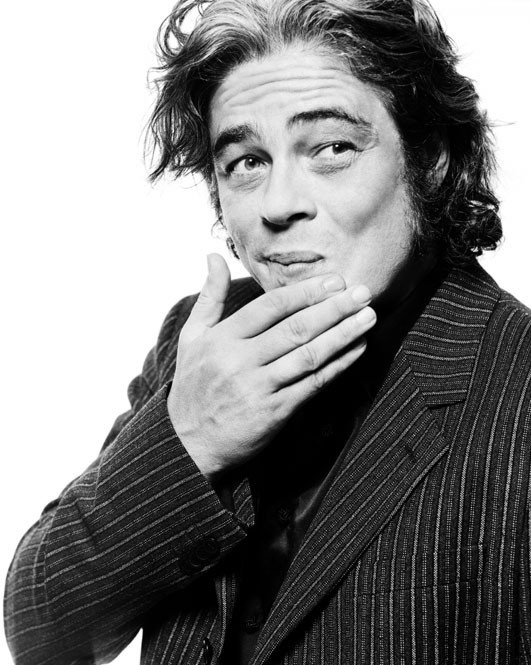
(Photograph by Darcy Hemley)


Top


  Back to Articles Archives