|
|
|
|
|
|
|
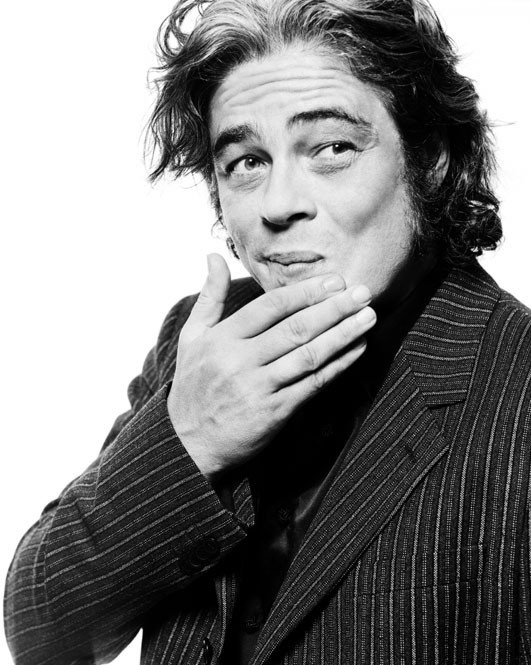
Benicio Del Toro Sneaks Up On Stardom
Latin Style |
|
|
| Back to Articles Archives | |||
|
|
Out of the more than 110 speaking roles in acclaimed director Steven Soderbergh's much talked-about ensemble Traffic, Benicio Del Toro is the one receiving the most attention. Traffic, a dense thriller set in Tijuana's underworld of drug trafficking, and the government agencies involved. It weaves together a series of loosely interrelated stories that show the high stakes and high risks of the illicit drug trade.
The film highlights the reality that drugs are one of the key social issues in today's culture: everyone knows at least someone who has been touched by it, whether it's a friend or a family member. Traffic takes the examination a step or two past what you might expect on-screen. The principal sub-plot revolves around an intriguing story in the film centered around Del Toro's character, Javier Rodriguez Rodriguez, a Tijuana State policeman. Javier works the border, a place in which the concept of law takes on a new meaning. Working under Mexico's number one crime fighter, General Salazar (played by Cuban-born actor Tomas Millian) Javier is continuously confronted by the temptations of power, but like Bogart in another era, he is protected in a loveless world by his personal code of honor. The stakes rise considerably but Javier decides not to sell out his integrity, but finds himself and his partner (Jacob Vargas) caught up in a web of deception and corruption with potentially fatal consequences. In order to establish a level of truth and realism, Soderbergh elected to film all the scenes taking place in Tijuana in Spanish with subtitles.
This aspect, along with the complexity of the character and the chance to work with Soderbergh, are what drew the highly respected Puerto-Rican born actor Del Toro to the film. "Steven Soderbergh is at the top of his game and working with him was a pleasure," said the charismatic Del Toro. "It was his idea to do [the Mexican story] in Spanish. I immediately said, 'That brings it to another level.' There's always a little bit of stereotype in thinking that south of the border everyone's corrupt. Usually in films that deal with drugs, they tend to push it in that direction, but Steven was trying to do the right thing. It was very important for me, and, also for Steve, to make sure that I portrayed a guy that people can relate to."
To prepare for his role, Del Toro spent time in Tijuana familiarizing himself with the way of life there. "I spent some time with a retired policeman in Tijuana who was a very good man and we talked about the problems there," he explained. "It never comes up in the film, but I just wanted to make myself informed. I think a lot of what I drew on for the character came from me too and, if it comes from me, it comes from all my influences, which starts with my dad. He was the first figure that I tried to emulate as a kid. It's funny because my brother saw the film and he said, 'Damn, you're like dad' a couple of times." Elaborating on his character's values, Benicio suggests, "Javier puts his life at risk to do what he does because he understands what is important for the future. "I think Javier's got a little bit of a vision," he said, "If you start taking the kids away from the street and educate them in some ways, you start working in the right direction. He's saying, 'Let's bring baseball to them. Instead of hanging around on the street corner, let's have kids play baseball and spend time doing something productive. Let's educate them.' I think that he has a vision and I like to think I have a vision too."
Even though both Soderbergh and Del Toro wanted to keep the dialogue for the Mexican segments in Spanish, there was some doubt that it would all work out. "I remember when I was talking to Steven right before we were going to shoot the film and we were closing my deal: there was a clause that said they couldn't lock it on my deal so that it would be in Spanish," explained Del Toro. "I said, 'Well, I'm not going to do it if they're going to dub it,' and I couldn't do it with one take in Spanish and one take in English. I said, 'Steven, forget it. I'm not gonna do it,' and he said, 'Listen, they're not going to do that.' But there was always that underlying feeling that maybe they're going to dub it.' They can dub it anytime before it opens, but I think the response has been exactly what Steven and I thought it would be. It's just going to add to the story."
Born in Santurce, Puerto Rico, Del Toro first captured critical attention as Fred Fenster in The Usual Suspects (1995). He next played Benny Dalmau in Basquiat (1996). Both earned him Independent Spirit Awards for Best Supporting Actor. Due to his standout performance in Traffic, Del Toro is now receiving quite a bit of Oscar buzz. When asked if he thinks the Academy, who is a rather conservative body of individuals, will recognize a film as innovative as this, Del Toro responded, "You never know, but I think it's a strong movie with a strong subject and it's well executed. The editing is great, the photography is great, the writing is great, the actors are great, and the directing is great." Del Toro has high praise for Steven Soderbergh and his filmmaking. "His approach is kind of like, 'Let's go do it,' and I like that," he said. "I think everybody in the film is great, from the little parts up, and it was a lot of fun doing the film, and that's kind of rare. I think a lot of that has to do with Steven and the way he runs the show. It's really very special. Every actor that I've talked to that's worked with Steven, including George Clooney and the many others that have worked with him, all say great things about him." Traffic has a sense of reality that makes the film feel like a documentary at times, due to its extreme attention to detail and such stylistic techniques as the use of different types of film stock for each of the films storylines. Even thought there is some concern that a film as innovative as this may not appeal to a larger audience, Del Toro feels that audiences are intelligent enough to get it. "I like the films that have been done in the past. They all have massive amount of detail. I really hold them close and will see them again and again. There are some movies that might come out and make you go, 'Wow!' They might make a lot of money from the beginning then reach number one at the box office, but three years from now, no one talks about them. Thirty years from now, Traffic will be interesting to look back at." |
|
|
| Back to Articles Archives | |||