Gun Crazy
IF Magazine
By Paul Zimmerman
September 8, 2000


  Back to Articles Archives  


WAY OF THE GUN stars Benicio Del Toro and Ryan Phillippe talk about whipping it out for first time director Christopher McQuarrie…


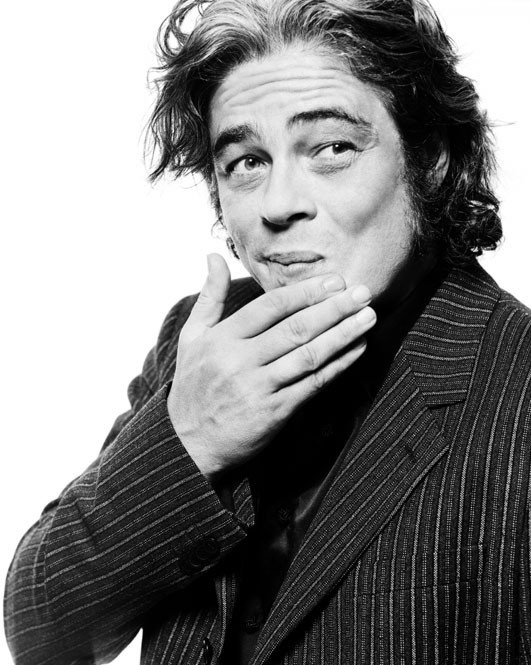
In their new movie WAY OF THE GUN, Ryan Phillippe and Benicio Del Toro play amoral kidnapers who communicate mostly by pulling their triggers. In person the duo play off each other almost like a comedy team. Phillippe, who's since lost the 30 pounds he put on to convince writer-director Christopher McQuarrie he could convincingly play a remorseless killer, speaks eloquently in crisp clipped sentences. Conversely, indie legend Del Toro slumps into his chair and adopts the shrugging, mumbling, beatific guise, all the while grinning and swallowing his answers.

It makes for a lively session when they meet up with a half dozen (plus) hungry reporters on a recent cloudless day at the Four Seasons Hotel in Beverly Hills. But it can also be an exercise in futility prompting one scribe to say aside, "When Del Toro starts trailing off in mid-sentence I want to jump up, stand on his shoulders, reach down his throat and YANK out the answers."

Which somehow seems an apt image befitting the new crime action art film that director McQuarrie says is really about the struggles of getting a film made in today's over processed, test screening son of a bitch they call Hollywood.

McQuarrie, of course, is the formerly white-hot screenwriter who won an Oscar for penning THE USUAL SUSPECTS way back in 1996. Since then however, he's found himself bounced from studio to studio as execs chimed "make another crime drama" and he countered with "I'd really like to helm a 60 million dollar film based on the life of Alexander the Great."

Finally after several dozen of these go-arounds McQuarrie agreed, at USUAL co-star Del Toro's insistence, to acquiesce and "write another crime film." But one with a vengeance and a provision. He would eschew all the usual niceties and make it compelling, complex and bordering on ugly.

Phillippe and Del Toro play Parker and Longbaugh, two fringe dwelling crime lifers who, while selling their fluids at a sperm bank, hear about a young woman (Juliette Lewis) being paid to have a baby for a wealthy family. The two screwballs decide to kidnap the pregnant woman, take her to Mexico and wait for the ransom as the deadpan narrator tells us "the longest distance between two points is a kidnapper and his money."

Having angered the wealthy surrogate father (Scott Wilson), who also just happens to be a gangster, all cinematic hell breaks loose as the dopey, doomed duo are soon pursued by yuppie hit men (Taye Diggs and Nicky Katt) and an aging sly enforcer (played with gusto by James Caan). Before film's end there's shoot-outs a plenty, a novel, a slow speed chase and a climatic gun battle in a Mexican whorehouse during an emergency C-section.

The resulting bloodbath is, depending on your temperament, hilarious, over-the-top nihilistic fun, exploitive nonsense, derivative drivel, even profound. Or if you want the easy way out, you just take one look a the crisp dialog and charismatic killers and scream "Tarantino-esque." (One scribe sniped "It just seemed so 1995.")

The dreaded QT remark (one of the long thought dead, glib bits of the past decade) is a pat comparison Del Toro and Phillipe obviously see coming.

BENICIO DEL TORO: (sitting up in his chair and taking notice) "Well it's not a Tarantino film. (mumble) It comes to you straight up. (something incoherent)"

RYAN PHILLIPPE: "Yeah. There's no fancy camera stuff."

DEL TORO: "Tarantino is a little bit more, (mumble) kind of like, yeah, I don't know, uh, I would say, like, (looks away, looks back intently) Chris McQuarrie punches you in the nose in a way. (pauses. Looks around. Gestures.) It's more about the consequences of having a gun in some ways. (The writers all lean forward, hanging on his every word) I think Tarantino is a great filmmaker, but I think this movie is very different than a Tarantino film."

PHILLIPPE:(speaking in perfectly annunciated sentences) "There are esthetic simulates but there is a lot more of an honest story told here in the sense where it's obvious in those movies who the bad guys are and who the cool guys are and this movie you make up your mind as you go along, it's not as black and white. There's shades of good and bad in each character and you're constantly trying to figure out if your allegiance is with them or you hate them."

With that matter settled, talk then turns to acting careers. Phillipe, who recently married and had a baby with his CRUEL INTENTIONS co-star Reese Witherspoon, explained his pretty boy image from films like the dud 54, are behind him now.

PHILLIPPE: "I'm not drawn to what is typical, I don't want to be considered typical. So I'm trying to follow my interests more, now that I have choices. When you're first starting you do what you can to get by, take what you can and then once you get there you try to be smart with it. Pick movies you feel could have an impact and are original. When I was 16 that's all I wanted to be, famous and have a lot of money. But when you get older your perspective changes. It mutates and becomes something bigger. I take it more seriously."

DEL TORO: (shrugs) "I just play my instrument. (laughs) And it's great to play with guys like Ryan and Jimmy Caan, Taye Diggs, Julliette Lewis and Nicky Katts. Working with Chris McQuirre again is almost like coming home."

With films like BASQUIAT, THE FUNERAL and SWIMMING WITH SHARKS under his belt, Del Toro is a certified indie star. But this art film jazz is a new tune for Phillippe. In fact, Phillippe admits scripts this meaty pass his way "never." So when McQuarrie originally passed on Phillippe playing the lethal Parker, it inspired him.

PHILLIPPE: "That's why it was so important for me to go after the role. Normally there is some sort of ego thing where you might say [after getting turned down], 'Oh they don't love me, screw them, they don't know what they're getting.' On this movie it was not like that, I understood why he would have reservations, I knew what the perception of me is for the most part. When I first read the script, in truth, I could see the guy older and bigger. I felt like I could make the transformation."

Del Toro stressed to McQuarrie that if he made a crime film he could make it his way and sneak in the stuff that really mattered to him. When the subject of the whole futile shoot outs being a metaphor for the struggles to get a film made come up Del Toro livens up and starts stringing together sentences that nearly make sense.

DEL TORO: "Yeah. (nods and clears his throat) Like when he said some people are more interested in becoming a criminal than committing a crime. (the woman next to me starts to speak and then instead scratches her head) Which is like style over substance kind of thing. (long pause) But he does have that feeling."

Phillippe somehow seems to have heard his cue and in the middle of one long pause he jumps in.

PHILLIPPE: "It's like those people who are more about wanting to be famous than wanting to do whatever it takes to get them deserved fame. In THE WAY OF THE GUN it's about resigning yourself to a fate of if this is all you're allowed to do, this is all you know, then you might as well do what you know."

So if characters Parker and Longbaugh are stand-ins for McQuarrie and his producer partner - long suffering pal Ken Kokin - who do the hit men played by Diggs and Katt represent?

DEL TORO: "(swallows a few words) Mmm. Agents? (mumbles something) Maybe. (Chuckles)"

Phillippe understands the oddness of the fact that he was playing a brusque kidnapper who's manhandling a pregnant woman on film while his real life wife was about to have their first child. Life didn't really imitate art or visa versa but he admits things did get odd.

PHILLIPPE: "There were times when it would hit me about how strange it was when we had to rough her around or whatever. I tried to separate it as much as I could but there were times I was so emotionally involved in what was going with Reesey [Witherspoon] - even though she was away from me -
that I think it left me at this basic sort of open place where it kind of worked for this character. Because these characters are kind of running on empty and they're guys who've been through a lot. Because it's very easy to understand that even the most hardened criminal feeling for a woman in her condition and for what we're putting her through."

As Phillippe talks about moving on and growing as an actor, Del Toro explains how he thinks he's perceived in Hollywood circles.

DEL TORO: "I don't know. (shaking his head) I don't know directors, you know? (pauses and laughs) I know that some say he's a method actor and in this day and age you say someone is a method actor, (stops and shifts gears, throwing the press into a flummoxed state) ... like in the '70s, a method actor was someone who needed psychiatric help. (everyone laughs) In the '70s it was cool. (slowing down again) In the '50s it was cool. In the '60s it was kinda cool to be a method actor, now it's kind of like well he's a problematic person."

With the press both hanging on his every word and laughing uncomfortably Del Toro shrugs and continues.

DEL TORO: "And all the method really is is common sense. (grunts) Horse sense. All about like, (gazing off a moment) - it's funny you know - Ryan gets shot in the leg and I remember him limping and then he takes off his shoe and he shows me he's got a rock in his shoe to force him to limp, so he won't forget. And then everyone will say, 'oh another trouble maker, another rebel.' " (laughs all around)

"It's all just common sense. Nothing like I took the character home, I'm walking around with a gun, I need to really kidnap somebody or get in my way and I'll shoot you man. Like I'm driving a car, I'm going 60 miles an hour I hit a wall and I'm going to get hurt. And the director might say 'No you're not. Not in this movie. It's a movie.' But that doesn't make any sense to me. That's what method is. But there's a stigma with method and most of the actors I like are method guys. Like Gary Oldman. Sean Penn. Robert DeNiro, Al Pacino, those guys."

The press leaning in on the edge of their chairs, anticipating a big finish get none. Del Toro smiles again and pauses until the subject is finally changed. As with all press junkets talk turns to future projects. Next up for Phillippe is a film called ANTI-TRUST and a website.

PHILLIPPE: "Seth Green (AUSTIN POWERS), Breckin Meyer (ROAD TRIP) and myself have something which would ideally be a smarter version of MTV in a sense. Shot films, animated shorts and lengthy discussions about music."

The ever busy Del Toro meanwhile has several respected films on the way including Steven Soderbergh's TRAFFIC, Sean Penn's THE PLEDGE and Guy Ritchie's follow up to LOCK, STOCK AND TWO SMOKING BARRELS, SNATCH.

REPORTER: Is that SNATCH or SNATCHED. Um or...?

DEL TORO: "(chuckles) Snatch. Not snatched with an ED. (mumbles) You know. Not like… (swallows something and smiles wide)."

And with that, the two men are on their feet and out the door...


Top


Top


Top


Top


Top


Top


Top


Top


  Back to Articles Archives