|
Method Man By Kimberly Cutter |
|||
| Back to Articles | |||
|
|
|
|
|
|
|
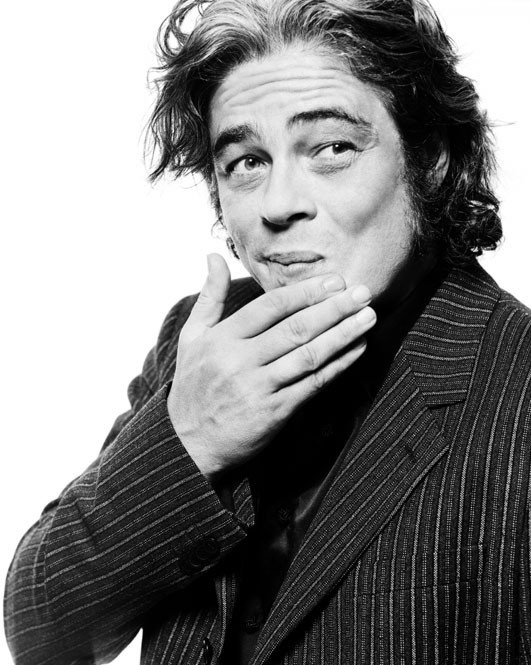
Benicio del Toro, Hollywood's sloe-eyed enigma, takes on yet another weighty role in 21 Grams.
The rooftop pool area at L'Ermitage Hotel in Beverly Hills is empty when Benicio Del Toro arrives for his interview. But rather mysteriously, the chaises suddenly begin to fill up, and within 20 minutes, the place is swarming and several young women in bikinis have taken to passing back and forth in front of Del Toro's cabana like zoo tigers at feeding time. One steps out of the pool, casts a long glance at the actor and beings a slow-motion towel-off routine, water pooling at her feet. Another sits up in her chaise, arches her back, and starts in with the Bain du Soleil. Meanwhile, the plump, middle-aged pool attendant is so excited that she's just forgotten Del Toro's drink order for the third time. "Pardon, señor. Pardon," she says, flushed and giggling.
If Del Toro, who stars alongside Sean Penn and Naomi Watts in Alejandro González Iñárritu's upcoming drama 21 Grams, notices anything unusual about all of this, you wouldn't know it. The actor plays things close to the vest, and his air of mystery is a significant part of his appeal. "He's very enigmatic, Benicio," Iñárritu says appreciatively.
Seated in the cabana, dressed in a black shirt and dark jeans with his silver-streaked pile of dark hair shoved under a trucker's hat, the 36-year-old actor keeps is famous hooded eyes mainly on the Camel Light he's smoking, lifting them now and then in a leonine yellow-green flash when he's making a point. When asked about the attention, he exhales slowly and admits, "It's weird." His voice is low and gravely with a slight Puerto Rican accent. "It's weird to have people looking at you all the time. And they come up to you, and you know, most of the time I don't mind." Del Toro pauses. "Well, if they're drunk, I do mind, or if you're concentrating on doing something, and someone comes and says, 'Hey, can you come over here and take a picture with my sister?' It can be annoying, but you have to know that it comes with the territory."
Del Toro, who has been exalted as "the next Brando" and "a Latino James Dean," snapped Hollywood to attention with his scene-stealing portrayal of Fenster, the natty, marble-mouthed hoodlum in The Usual Suspects (for which he received an Independent Spirit award). Though he bagged another Independent Spirit Award for his role in Julian Schnabel's Basquiat, it wasn't until he toned things down a couple of notches for his masterful performance as a sad-eyed cop in Steven Soderbergh's Traffic that he emerged as the new dark prince of American cinema, winning an Oscar for best supporting actor - not to mention the hearts of young ladies from sea to shining sea.
His colleagues are not immune to his appeal. "He could do nothing onscreen and he would be interesting to watch," Watts says. "Those eyes are so soulful and deep. They express so much sadness and strength." Penn describes him as "this big smoky-eyed 'Rican who has a great kind of stillness and dignity about him." And Iñárritu likens him to a black panther. The whole panther mystique is only magnified by the fact that despite being romantically linked to actresses Alicia Silverstone, Claire Forlani, Valeria Golino and Chiara Mastroianni (the daughter of Catherine Deneuve and Marcello Mastroianni), Del Toro remains single, living in an apartment in West L.A. that by all accounts is furnished primarily with books and CDs, and driving a dusty Bronco that dates back to the early Nineties. He loves the Stones and Zeppelin and Hemingway and Dostoyevsky. He oil-paints in his spare time. He smokes constantly and has a tendency to isolate himself or, as he puts it, "to go inside a bubble."
"I'm not really a chitchat kind of guy," he explains. "I'm kind of like, if I want to get into a conversation, I want to have a conversation." The same holds true for his taste in film, which runs from dark (the arty film-student favorite Andrei Rublev) to darker (Taxi Driver). And though he admits to a weakness for the occasional Farrelly brothers flick, Del Toro clearly prefers "books and films that have substance and deal with big things."
To be sure, Del Toro has dealt with his own share of "big things" offscreen. Born into a prosperous old Puerto Rican family in the colonial city of San German (Captain Don Miguel Del Toro first settled in the area in 1510), he is the youngest son of two lawyers, Gustavo Del Toro and Fausta Sanchez, who moved the family to the San Juan suburb of Santurce when Benicio was a child. When he was nine, his mother contracted hepatitis from a blood transfusion, and she died shortly thereafter. His father built a lighted basketball court to help the children deal with the loss, and Benicio and his brother, Gustavo Jr. (now a prominent Manhattan oncologist), quickly became fanatics. Meanwhile, his relationship with his father deteriorated. "We clashed when I was younger," he admits. "My dad was old-school. He was very strict. It was like, 'You gotta clean up now, and if you go out without cleaning up, well, then, when you come back. uh-oh.'" Del Toro's eyebrows go up. "He was a big guy."
Tensions escalated when, two years after his mother's death, Del Toro's father remarried and Del Toro developed a pendant for pranks, such as lobbing a smoke bomb into a local beauty parlor. At age 13, he was sent off to Mercersburg Academy in rural Pennsylvania, where the high jinks continued. "I was a f---up," he says. "I liked the kids there, but I was not too crazy about most of the teachers." Though Del Toro became cocaptain of the basketball team, his grades were less than stellar and, as he says with a rueful grin, "the conduct was not really. panning out."
Nevertheless, he managed to get himself admitted to the University of California at San Diego, where he enrolled as a business major - until an acting class caught his attention. He soon found his way to New York, where he spent a summer performing with Circle in the Square while bunking with a cousin on Central Park South. "I lied to my dad about that," says Del Toro, who'd claimed he was receiving college credit. "They were not thrilled about me acting." But instead of going back to college, he won a two-year scholarship to the Stella Adler Conservatory in Los Angeles, and his father stopped speaking to him for six months.
"Sometimes I look around L.A. and go, Why did I end up here?" Del Toro says. "And I think I was running away from my family, because, you know, I can love them hard from here. As much as I love my brother and all that, you get in the room with them, and it's like, just a facial twitch can set me off.'cause they know your bulls ." He pauses. "I think a lot of people who move here are running away. I'm definitely one of those."
Although his father came to accept his career choice once he saw him in The Usual Suspects, there were eight long, lean years between Del Toro's arrival in L.A. and his 1995 breakout during which he had to trudge through a bunch of thankless roles: Duke the Dog-Faced Boy in Big Top Pee-wee, a rapist in Christopher Columbus and a villain opposite Timothy Dalton's stone-faced Bond in License to Kill. He did some bad TV (ever hear of the series Shell Game or O'Hara?) and played a drug lord in a miniseries.
Then he started making trouble. Inspired by the risky Method work of actors like Marlon Brando, Al Pacino and Robert Duvall - he describes Brando's performance in On the Waterfront as a "revelation" - Del Toro decided to start taking some risks of his own. "I think any character who goes against the grain is interesting," he says. "Maybe it's a romantic idea that I have about people standing up for what they believe in and ignoring the odds and not following. but I like people when they make choices for themselves. I like people who take chances."
In the short run, the approach proved disastrous. Del Toro was nearly fired from Fearless after turning in what he considered a "balls-out" performance. Swimming With Sharks was a similar experience. (As he once recounted, "The director kept screaming, 'He's playing it like a fag" He's stoned! I don't know what he's doing'") His agent called him and said, "We can't go on like this. Every movie you work on, it's a nightmare."
"It was hard," admits Del Toro, who got so depressed after his first day on The Usual Suspects - having begun to doubt his decision to play Fenster with an all but unintelligible mumble - that he got lost driving home. "I mean, I've always had a big ego, but there have been so many times when I've taken a chance, and no one gets it. no one. Not event the director". He shakes his head. "And you're just alone, feeling like a complete leper, even though you knew what you were doing and the logic behind it." Del Toro shrugs. "But lots of guys had it hard in the beginning. I sat down with Jack Nicholson, and he was like, 'Oh, my God, people thought I was nuts.'"
He followed his gut, though, and Hollywood came around. "The way that he thinks is just so uncommon," Penn offers. "Everybody has their own truth in life, but the truth Benicio sees is a lot more fun to watch."
Iñárritu recalls a night in Memphis, during a break from filming 21 Grams, when some of the cast and crew went to Sun Studio, where Elvis recorded, and over numerous drinks laid down a few tracks for fun. "Benicio decided to record this version of 'Shake, Rattle and Roll.' He didn't sing it; he just read the words out loud," Iñárritu remembers. "It was like a complete rediscovery of the song. It took on a whole new depth and meaning, and you'd say you'd never heard it before. That's what he does with his characters, too. He takes a story you think you've seen a thousand times and transforms it into something else entirely. He makes it new."
In 21 Grams, Del Toro plays a flawed yet noble born-again ex-con whose faith is tested when fate involves him in a hideous car accident. Revolving around the lives of three characters (Del Toro, Penn and Watts) who become intertwined as a result of the accident, the film is every bit as grim as Iñárritu's Amores Perros. It's Del Toro's most intimate, soul-searching performance to date, and it seems likely to earn him another Oscar nomination. "The hardest part was trying to steal the show from Sean," quips Del Toro, who had previously appeared in two Penn-directed features, The Pledge and The Indian Runner.
"No," he goes on seriously, "the hardest thing really was how emotional the role was, because sometimes I hide behind my physicality; you know, if something is hard to do emotionally, I'll be the first one to dive on the floor and cover my face, and in this film I couldn't do that. I had to stay focused. It's almost like you have to hold your breath underwater, and then you come up for a quick breath, and then you have to go back down."
Del Toro says he's become better at leaving his characters' baggage behind at the end of the day, but he acknowledges that the work doesn't leave much energy for his romantic life. "I think when it comes to relationships, the person would have to be really strong and really mature for it to work," says Del Toro, who is currently "seeing someone" whom he declines to name. "Both people would have to be, and I don't know if I've achieved that maturity yet. Relationships are hard. Forget relationships between actors; relationships in general are hard."
The fact that Del Toro is at a pivotal stage in his career only complicates matters further. "Right now, I'm in an interesting place as an actor," he says, "because I get to pick a little bit more than I used to, so I think this is the time to get things going."
Though it was recently announced that Del Toro will make his directing debut with the film version of the Hunter S. Thompson novel The Rum Diary, with an all-star cast including Nick Nolte, Josh Hartnett and Johnny Depp (Del Toro's costar in the adaptation of Thompson's Fear and Loathing in Las Vegas), he says it's "too early to talk about" the project. Instead he mentions a Che Guevara biopic that he's trying to find the money for. He's also slated to star in Chaos, a film with Sexy Beast director Jonathan Glazer, opposite Robert De Niro.
Once again, he seems to be entering dark dramatic territory - a fact that strikes him as ironic. "The funny things is I was originally attracted to acting because I was a clown when I was younger," he says. "Still am a little bit. But hey," he adds, grinning, "I have an image to keep up." |
|
|
|
|
|
|
|
![]() |
|||
|
|
|
|
|
|
|
|
||
|
|
|
|
|
|
|
|
||